How cells shred their own recipe cards: microRNA in two registers
In 2024, Victor Ambros and Gary Ruvkun won the Nobel Prize for discovering microRNA. For a long time it was believed that the main principles of gene regulation had been solved; their discovery proved that cells also hold or destroy their own recipes after they leave the vault. Checked 11 October 2026.
Every cell in your body carries the exact same genome. A muscle cell, a brain neuron, and an intestinal cell read from identical DNA instruction books. As the Nobel Committee noted in its announcement: “for a long time it was believed that the main principles of gene regulation had been solved.” But Ambros and Ruvkun revealed an unexpected layer, as the advanced scientific background explains: “Whereas proteins in the nucleus regulate RNA transcription and splicing, microRNAs control the translation and degradation of mRNA in the cytoplasm.”
 AI
| What the Nobel citation says (verbatim) | What it means (for a 12-year-old) |
|---|---|
| “Genetic information flows from DNA to messenger RNA (mRNA), via a process called transcription, and then on to the cellular machinery for protein production.” | Your DNA is a locked library book that never leaves the office. To build a part, the cell photocopies one page onto a ribbon called messenger RNA and carries it out to the 3D printer (the ribosome). |
| “The lin-4 gene produced an unusually short RNA molecule that lacked a code for protein production.” (The advanced scientific background notes this as a “short 22-nucleotide noncoding RNA”.) | Most genes carry blueprints for building an actual machine or tissue. This gene made a tiny scrap of ribbon only 22 letters long that didn't build anything at all. |
| “it is not the production of mRNA from lin-14 that is inhibited by lin-4. The regulation appeared to occur at a later stage in the process of gene expression, through the shutdown of protein production.” | The recipe ribbon was still printed and sent to the kitchen. But the meal never came out. Something was stopping the cook midway. |
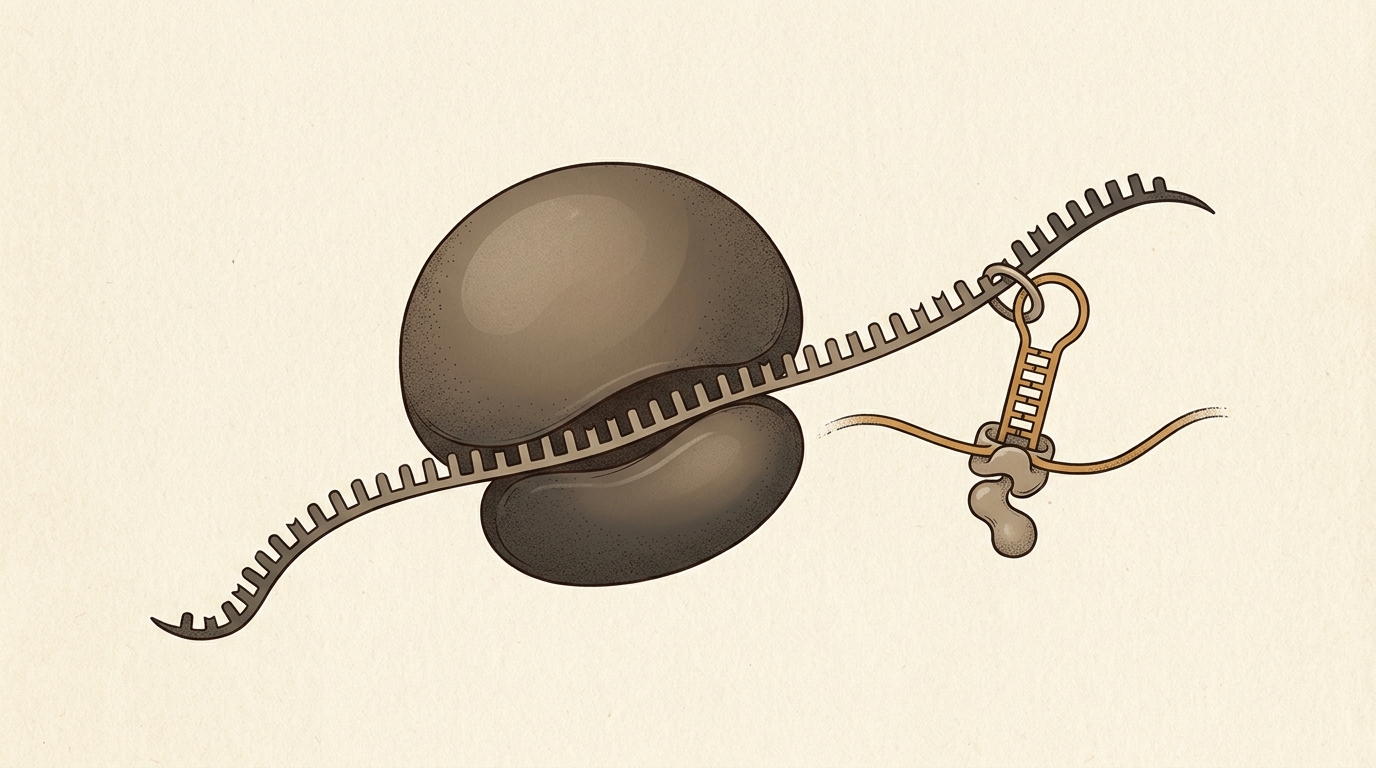
| “The short lin-4 sequence matched complementary sequences in the critical segment of the lin-14 mRNA.” | The tiny scrap acted like a strip of velcro: its chemical letters were a close but partial match to the trailing tail of the recipe ribbon, so it snapped tight to the edge. |
| “The binding of microRNA leads to inhibition of protein synthesis or to mRNA degradation.” | Once the velcro patch snaps onto the tail, the 3D printer jams and cannot finish the job—or a cellular paper shredder comes along and chews the recipe ribbon up. |
Why it took 31 years
When Victor Ambros and Gary Ruvkun published their findings in 1993 in two articles in the journal Cell, other geneticists assumed it was an oddity of a 1 mm roundworm (C. elegans). As the Nobel press release records: “The published results were initially met with almost deafening silence from the scientific community. Although the results were interesting, the unusual mechanism of gene regulation was considered a peculiarity of C. elegans, likely irrelevant to humans and other more complex animals.”
That changed in 2000, when Ruvkun's team discovered a second microRNA, let-7, which was “highly conserved and present throughout the animal kingdom”, with orthologues of its target identified across humans, fruit flies, and zebrafish in the advanced scientific briefing. Today, the Nobel Committee notes that “there are more than a thousand genes for different microRNAs in humans, and that gene regulation by microRNA is universal among multicellular organisms.” Cells do not merely decide what orders to print; they run a continuous post-office shredder to adjust the volume.