How LIGO caught two stars colliding 130 million light-years away, explained for a 12-year-old and for an adult
When two neutron stars collided 130 million light-years away, their ripples traveled across the universe to Earth. On Earth, laser detectors capable of measuring shifts ten thousand times smaller than a single proton recorded the signal. Checked 11 October 2026.
Gravitational waves are ripples in space-time. Einstein's general theory of relativity predicts that they travel at the speed of light. The distortion reaching Earth is so small that measuring it took detectors built for the job. The Laser Interferometer Gravitational-Wave Observatory (LIGO) achieved this with two identical 4-kilometre detectors in Hanford, Washington, and Livingston, Louisiana.
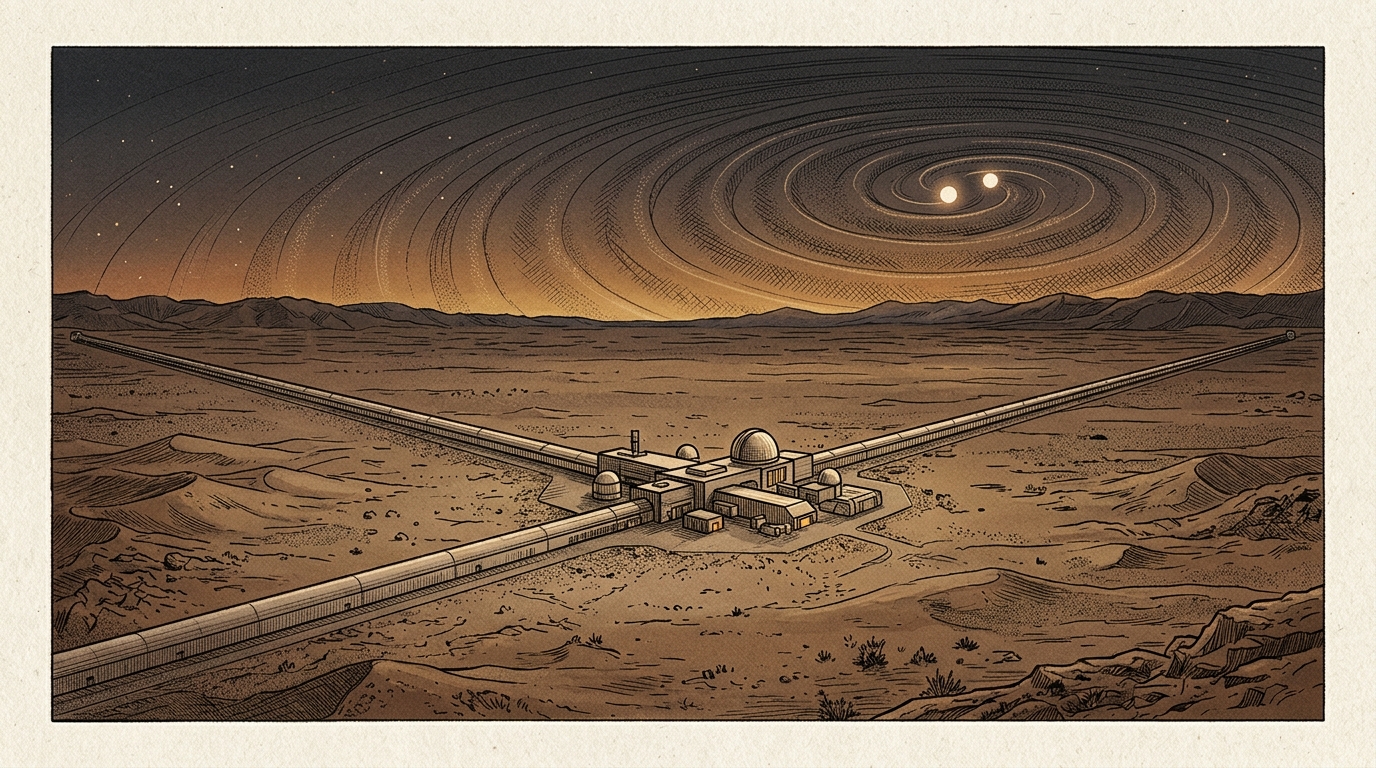 AI
| What the LIGO laboratory records (verbatim) | What it means (for a 12-year-old) |
|---|---|
| “Each observatory consists of two long tunnels arranged in an L shape, at the joint of which a laser beam is split in two.” | Scientists built two identical giant L-shaped ruler stations in two different states, so a real cosmic signal can be confirmed at both sites. |
| “Over the 4km length of each arm, the Earth curves away by nearly a meter!” | The tunnels are so long and straight that the Earth actually curves away beneath the concrete floor: by the time you reach the end, the dirt has dropped nearly a metre below the beam. |
| “The pressure inside LIGO's vacuum tubes is one-trillionth of an atmosphere” | To stop light beams bumping into air molecules, engineers pumped nearly all the air out of the four-kilometre steel tubes so the laser travels through clean vacuum. |
| “At its most sensitive state, LIGO will be able to detect a change in distance between its mirrors 1/10,000th the width of a proton!” | When a gravitational wave passes, it doesn't push the mirrors; it literally stretches space in one direction and squashes it in the other, shifting the laser path by less than the size of an atomic nucleus. |
| “This is equivalent to noticing a change in distance to the nearest star (some 4.2 light years away) of the width of a human hair.” | Imagine measuring the distance to the next solar system four light-years away, and noticing that a single strand of hair was added to the gap. That is how sharp the detector is. |
The neutron star collision: GW170817
On 17 August 2017, the observatory recorded its most celebrated signal: “The gravitational signal, named GW170817, was first detected on Aug. 17 at 8:41 a.m. Eastern Daylight Time; the detection was made by the two identical LIGO detectors, located in Hanford, Washington, and Livingston, Louisiana.” As the wave crossed Earth, “If a gravitational wave passes through the observatory, it will alter each laser beam’s arrival time, creating an almost imperceptible change in the observatory’s output signal.”
When the neutron stars collided, a flash of gamma rays was “seen on Earth about two seconds after the gravitational waves.” The joint detection showed that gravitational waves and light arrived across 130 million light-years within two seconds of each other, which Caltech notes “provide confirmation for Einstein’s general theory of relativity, which predicts that gravitational waves should travel at the speed of light.”