Skip to content
medium-roast
Monday 16 November 2026

How America's first CRISPR medicine treats sickle cell disease, explained for a 12-year-old and for an adult

In December 2023, the US FDA approved Casgevy, the first FDA-approved medicine to use CRISPR/Cas9 genome editing, treating sickle cell disease by increasing the production of fetal hemoglobin that prevents red blood cells from sickling. Checked 11 October 2026.

93.5%
of evaluable trial patients (29 of 31) free from severe crises for at least 12 consecutive months
44
patients treated with Casgevy in the FDA approval trial
100%
achieved successful engraftment with zero graft rejections

Sickle cell disease is caused by an inherited mutation in hemoglobin, causing red blood cells to develop a crescent or sickle shape that restricts blood flow and starves tissues of oxygen, leading to severe pain called vaso-occlusive crises. But the body also carries a recipe for fetal hemoglobin (HbF), which facilitates oxygen delivery without sickling. As the US Food and Drug Administration recorded in its approval announcement, Casgevy uses CRISPR to modify blood stem cells to turn that fetal production back up.

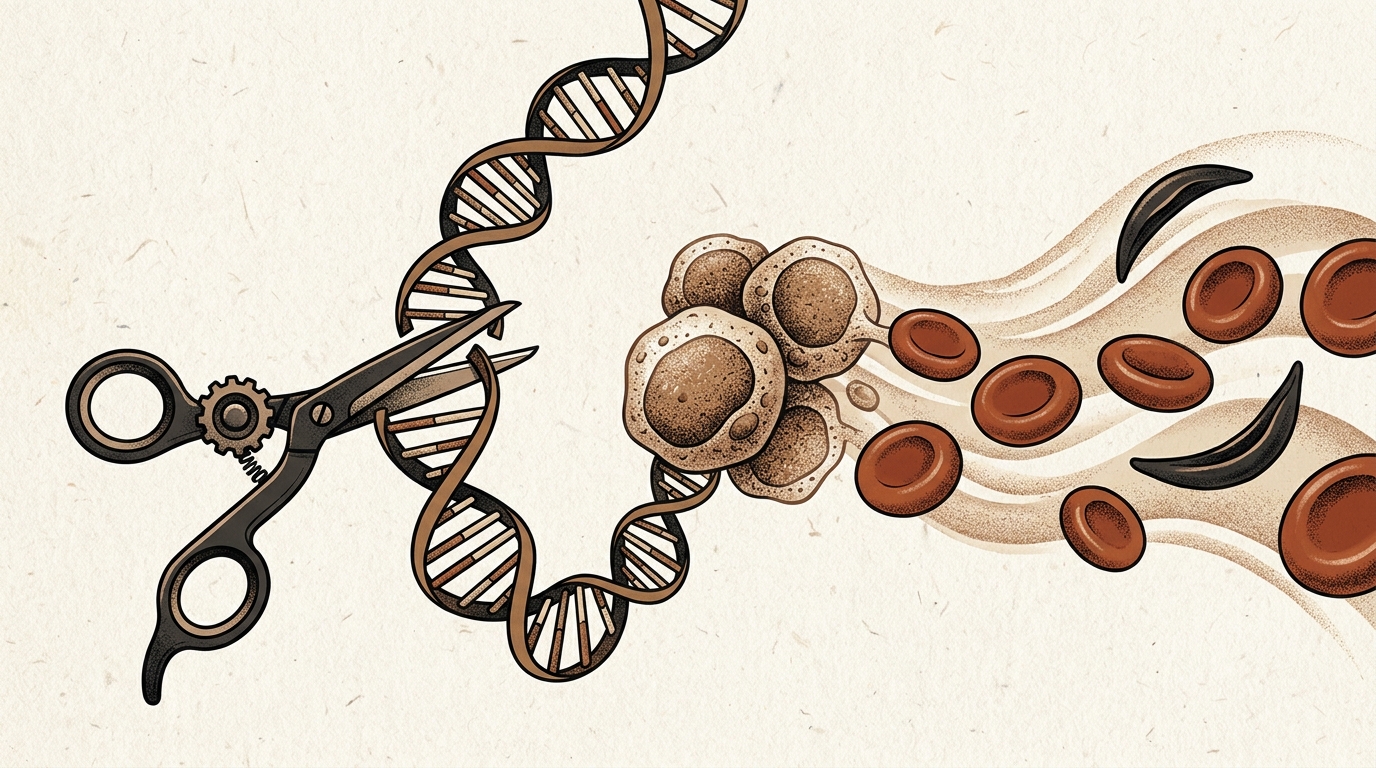
An editorial illustration of stylized molecular scissors cutting a DNA strand, with bone marrow stem cells producing round, smooth red blood cells flowing beside crescent sickle cells.AI
What the FDA approval says (verbatim) What it means (for a 12-year-old)
“Casgevy is the first FDA-approved therapy utilizing CRISPR/Cas9, a type of genome editing technology. Patients’ hematopoietic (blood) stem cells are modified by genome editing using CRISPR/Cas9 technology.” Doctors harvest root cells from your bone marrow that grow into all your blood. In a laboratory dish, they send in microscopic chemical scissors to edit the instruction code.
“CRISPR/Cas9 can be directed to cut DNA in targeted areas, enabling the ability to accurately edit (remove, add, or replace) DNA where it was cut.” Instead of rewriting millions of genetic letters, the molecular scissors make a targeted cut that lets the body turn baby blood back on.
“The modified blood stem cells are transplanted back into the patient where they engraft (attach and multiply) within the bone marrow and increase the production of fetal hemoglobin (HbF), a type of hemoglobin that facilitates oxygen delivery.” The edited seeds are pumped back into your veins. They settle into the marrow soil, take root, and start churning out round, smooth baby blood cells that carry oxygen easily.
“In patients with sickle cell disease, increased levels of HbF prevent the sickling of red blood cells.” Because baby blood cannot form jagged clumps, your red blood cells stay soft and cushiony like water balloons, slipping smoothly through tiny vessels without causing traffic jams.
“Prior to treatment, a patients’ own stem cells are collected, and then the patient must undergo myeloablative conditioning (high-dose chemotherapy), a process that removes cells from the bone marrow so they can be replaced with the modified cells” Before the new edited cells can move in, doctors use high-dose chemotherapy to clear out the old stem cells living in your bone marrow to make room.

The clinical trial numbers

The FDA evaluated Casgevy in adolescent and adult patients with a history of recurrent severe crises: “The primary efficacy outcome was freedom from severe VOC episodes for at least 12 consecutive months during the 24-month follow-up period. A total of 44 patients were treated with Casgevy. Of the 31 patients with sufficient follow-up time to be evaluable, 29 (93.5%) achieved this outcome. All treated patients achieved successful engraftment with no patients experiencing graft failure or graft rejection. The most common side effects were low levels of platelets and white blood cells, mouth sores, nausea, musculoskeletal pain, abdominal pain, vomiting, febrile neutropenia (fever and low white blood cell count), headache and itching.”

The FDA notes that patients who receive the treatment “will be followed in a long-term study to evaluate each product’s safety and effectiveness.” Rather than fixing the mutated adult hemoglobin gene directly, the therapy demonstrates that genetically modified blood stem cells can prompt the body to manufacture red blood cells that increase fetal hemoglobin and prevent sickling.